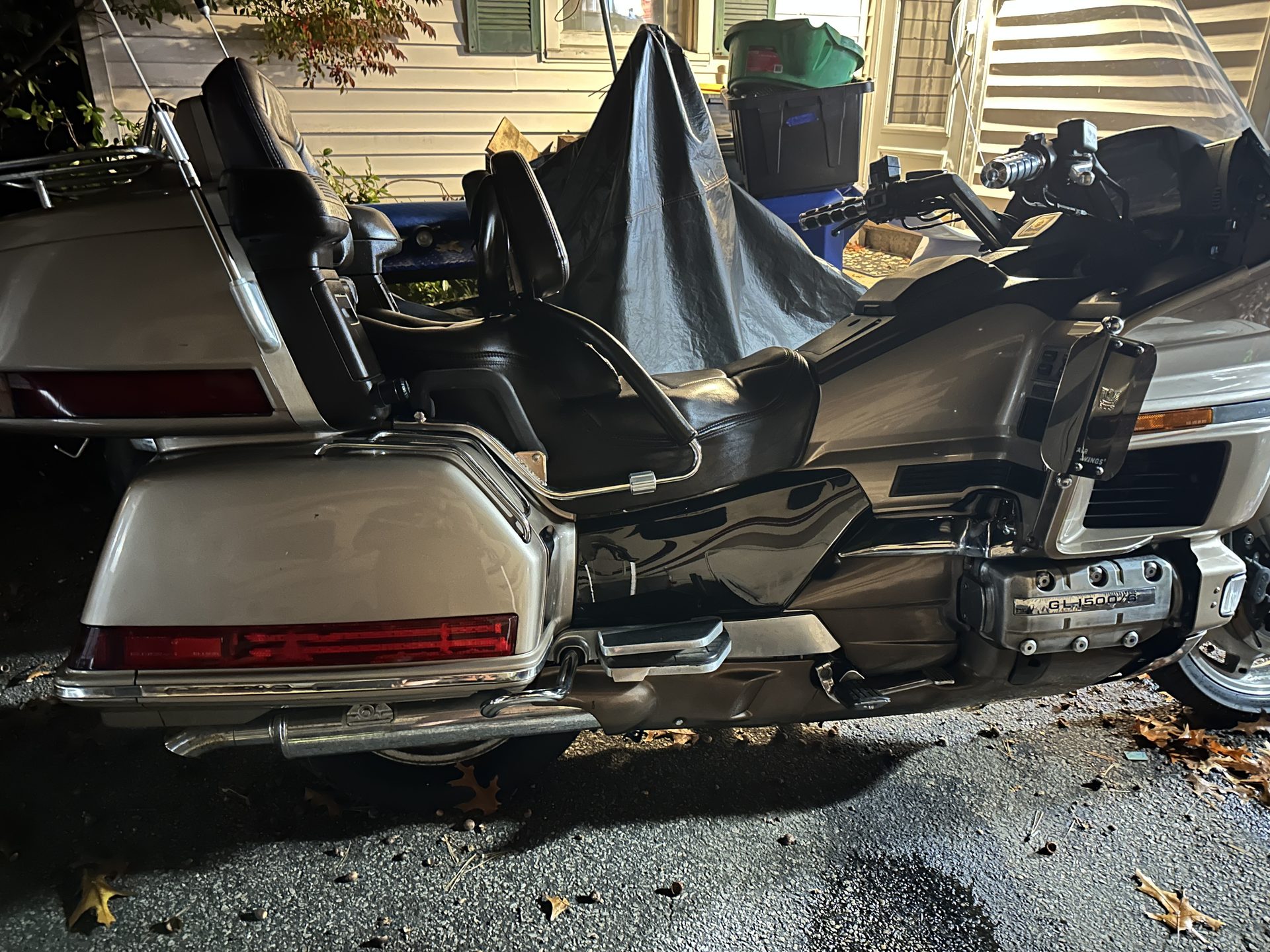
Winter is when we think back over the bikes we worked on and what they taught us. This season that means Gold Wings. The GL1500 is a big, smooth, well-built touring bike, and that is exactly why so many of them get parked for years instead of scrapped. When they come back to life, they come back with surprises.
Here are the real ones from our own shop notes, mainly from Kindle, our 1988 GL1500 and Ember, our 1989 GL1500.
1. The choke was hiding the real problem
Kindle would idle only with the choke on. Choke off, it died. Its carbs had already been rebuilt once.
It is easy to assume the choke is broken. It was not. The choke was masking a lean idle: the pilot circuit, the tiny passages that feed the engine at idle, was starved. The choke was simply adding enough fuel to cover for it.
The lesson: a bike that only runs on choke usually has a fuel delivery problem at idle. Our check order was the pilot jet and its passage (cleaned with compressed air, never wire or a drill bit), the pilot screw setting, the O-rings and gaskets between the carb bodies (an air leak there causes the same symptom), and the starter valve needle and seat.
2. The first rebuilt carb would not run, so we built another
Even after all that, the first rebuilt carburetor would not run on Kindle. So we built a second one from scratch: cleaned, rebuilt, new boots, seals and vacuum lines. On October 12 we swapped it in and the bike idled beautifully. After a proper vacuum sync on October 13, it sat at 40 mmHg across both sides and idled at 860 rpm off choke, with no bog and no leaks.
The lesson: sometimes the fastest way through a stubborn carb is not one more cleaning. It is a known-good rebuild.
3. Check which carburetor you actually have
When we pulled specs for Kindle, we found the 1988 bike carries a different carb ID than the carburetors used on later GL1500s. Some of the later addenda list different numbers for things like the pilot screw opening and the float level. A forum post we found disagreed with the manual on the pilot screw, too.
The lesson: use the service manual for your exact model year and carb ID. When a forum and the manual disagree, the manual wins, and the physical carb is worth a sanity check when it is apart.
4. A stuck float on Ember
Ember had its own running problem. The root cause was a stuck float in the carburetor. The carbs were rebuilt and retuned, and it ran properly after that.
The lesson: float problems are a classic result of a bike sitting. Varnish and old fuel make floats and needles stick, and the symptoms can look like a lot of other things.
5. Not every leak is a fuel leak
On one of our Gold Wings this season, a temperature and leak complaint first got lumped in with the carb trouble. It turned out to be coolant, not fuel, with the water pump weep hole as the likely source. The rough running was its own separate problem.
The lesson: on a liquid-cooled bike, smell and look before you blame the carbs. Two problems at once can masquerade as one.
6. Seized does not mean finished
Kindle's engine was seized when work began. We freed it, found 125 psi of compression in the healthy cylinders, and pulled all twelve hydraulic lifters. Once the starter was fixed and every lifter serviced and bled, Kindle fired on February 26 for the first time in years, idling at 1,800 rpm untuned on a spare carburetor.
The lesson: a seized GL1500 is not automatically a parts bike. Go slow, and measure before you decide.
7. Small fasteners, big delays
On the first day of Kindle's nine-day finish, a broken valve-cover bolt had to be extracted and replaced before anything else could move forward.
The lesson: on a bike this age, plan time for broken and seized fasteners. They will be there.
8. Rubber ages whether you ride or not
Kindle's tires had 2001 date codes. By the end, short of pulling the engine, every rubber hose, vacuum line, carburetor, intake boot and seal on Kindle was replaced.
The lesson: on a long-parked Gold Wing, assume the rubber is done. Budget for it from the start.
The short version
- A choke-only idle usually means a starved pilot circuit or an air leak
- A known-good carb rebuild can beat endless cleaning
- Match specs to your model year and carb ID
- Long storage makes floats stick
- Separate coolant problems from fuel problems
- Measure a seized engine before you give up on it
- Expect broken fasteners
- Replace old rubber
These are exactly the kinds of jobs that make good winter projects. That is the next post.